The Purpose Of Valuation And Its Impact On Valuation Exercise

The Purpose Of Valuation And Its Impact On Valuation Exercise!

Business valuation is a crucial aspect of the decision-making process for investors, entrepreneurs, and other stakeholders. The purpose of valuation is to estimate the value of an asset, such as a business or real estate, to help make informed decisions about its future. However, the purpose of the valuation can significantly impact the valuation exercise, leading to different results and outcomes.

Business valuation is a process that determines the value of a company based on a combination of financial, economic, and market factors. The purpose of the valuation is a critical factor that influences the methodology, assumptions, and inputs used in the valuation process. Understanding the purpose of the valuation is essential to ensure that the valuation exercise is reliable and relevant.

The following are some of the key purposes of business valuation and the impact that they have on the valuation exercise:

  • Mergers and Acquisitions (M&A) – One of the most common purposes of business valuation is for mergers and acquisitions (M&A) transactions. In M&A transactions, the valuation of a company is used to determine the purchase price, allocate purchase price between the assets and liabilities, and calculate the residual value of the company. In M&A transactions, the valuation exercise is typically conducted using a combination of the market approach, the income approach, and the cost approach. The valuation must be reliable and relevant to ensure that the purchase price is fair and reasonable.
  • Financial Reporting – Another common purpose of valuation is for financial reporting purposes, such as for annual or quarterly financial statements. In financial reporting, the valuation of a company is used to determine the fair value of assets and liabilities, including financial instruments and intangible assets. The valuation must be reliable and relevant to ensure that the fair value estimate is accurate and that the financial statements are transparent and understandable. Financial reporting requires valuing assets and liabilities in accordance with accounting standards, such as Generally Accepted Accounting Principles (GAAP) or International Financial Reporting Standards (IFRS). This type of valuation is focused on historical financial performance and the value of assets and liabilities as of the reporting date. Financial reporting valuations are often conducted using more conservative valuation methods and can result in a lower value estimate compared to other purposes of valuation.
  • Taxation – Business valuation is also used for tax purposes, such as determining the fair market value of assets and liabilities for estate and gift tax purposes, calculating the taxable gain or loss on the sale of assets, and determining the value of assets for tax purposes. In taxation, the valuation must be reliable and relevant to ensure that the taxpayer pays the correct amount of tax and that the tax authorities have accurate information for tax purposes. Taxation valuations require considering the specific tax regulations and laws applicable to the asset or business being valued. This type of valuation can result in a lower value estimate compared to other purposes of valuation, as tax regulations may restrict the methods that can be used for valuation and limit the value that can be attributed to certain assets.
  • Litigation – Business valuation is also used in litigation, such as in disputes over the value of a company or its assets, the calculation of damages, or in shareholder disputes. In litigation, the valuation must be reliable and relevant to ensure that the parties have accurate information for settlement negotiations and that the court has accurate information for decision-making purposes. Litigation valuations are often conducted under tight deadlines and require a thorough understanding of the legal context of the dispute. The focus of this type of valuation is often on the value of an asset or business as of a specific date and may consider factors such as market trends and economic conditions as they relate to the dispute.
  • Strategic Planning – Business valuation can be used for strategic planning purposes, such as determining the value of a company for the purpose of setting a selling price, determining the value of a company for the purpose of making investment decisions, or for setting goals and targets for a company. In strategic planning, the valuation must be reliable and relevant to ensure that the company has accurate information for decision-making purposes. One of the most common purposes of valuation in strategic planning is to support investment decision-making. This includes assessing the potential return on investment (ROI) for potential investors, as well as the value of a business for potential acquirers. When valuing a business for investment purposes, the focus is often on its future potential, including expected revenue growth and profitability. This type of valuation requires a forward-looking approach and can be influenced by various factors, including market trends, competitive landscape, and the company’s competitive advantage.
  • Market Analysis – Market analysis valuations are conducted to estimate the value of a specific market or market segment. This type of valuation is often focused on the aggregate value of the market and its growth potential, as well as its current state. Market analysis valuations are used to inform investment decisions and support market research initiatives.
  • Financing – Valuation is also frequently used to support the financing of a business. In this context, the valuation is used to determine the amount of financing that can be obtained and the terms of the financing. The purpose of the valuation in this case is to provide a realistic assessment of the value of the business and its potential for growth.

Conclusion

The purpose of valuation can significantly impact the valuation exercise, leading to different results and outcomes. Understanding the purpose of the valuation is crucial in determining the appropriate valuation method, data sources, and assumptions to be used in the valuation exercise. The purpose of business valuation is a critical factor that influences the methodology, assumptions, and inputs used in the valuation process. Understanding the purpose of the valuation is essential to ensure that the valuation exercise is reliable and relevant. It is important to ensure that the valuation is conducted in accordance with best practices and industry standards. This will help to ensure that the valuation exercise is reliable and relevant, providing accurate information for decision-making purposes. Whether for investment decision-making, financial reporting, taxation, litigation, or market analysis, the purpose of valuation should be clearly defined to ensure that the valuation estimate is accurate and relevant to the decision at hand.


Valuation Adjustments In Fair Value Measurement

Valuation Adjustments In Fair Value Measurement

As per International Valuation Standards (IVS), fair value measurement is the process of estimating the price that would be received for an asset or paid for a liability in an orderly transaction between market participants at the measurement date. The valuation adjustment is a crucial aspect of the fair value measurement, as it helps to reflect the market participants’ expectations about the future market conditions and the effects of these conditions on the value of an asset or a liability.

Valuation adjustments are adjustments made to the fair value measurement of an asset or liability to reflect specific circumstances that may affect the value of the asset or liability. According to the International Valuation Standards (IVS), valuation adjustments are an important part of the fair value measurement process, as they help to ensure that the value of an asset or liability reflects its true market value. They can mainly include adjustments for factors such as illiquidity, credit risk, and non-performance risk.

  • Illiquidity Adjustments > Illiquidity adjustments reflect the market participants’ expectations about the difficulties in selling an asset or liability. These adjustments can be made by adjusting the price of the asset or liability to reflect the reduced demand for the asset or liability due to its illiquidity.
  • Credit Risk Adjustments > Credit risk adjustments reflect the market participants’ expectations about the default risk of an issuer or borrower. These adjustments can be made by adjusting the yield or spread on the asset or liability to reflect the increased risk of default.
  • Non-Performance Risk Adjustments > Non-performance risk adjustments reflect the market participants’ expectations about the risk of non-performance, such as the risk of default or prepayment. These adjustments can be made by adjusting the yield or spread on the asset or liability to reflect the increased risk of non-performance.

There are many different types of valuation adjustments that may be made, depending on the nature of the asset or liability being valued and the specific circumstances of the valuation. Some common types of valuation adjustments include:

  • Market illiquidity: If the market for an asset or liability is not liquid (i.e., it is difficult to buy or sell the asset or liability), this may affect the value of the asset or liability. In this case, a valuation adjustment may be made to reflect the impact of the illiquidity on the value of the asset or liability.
  • Controlling interest: A controlling interest refers to the ownership or control of a majority of the voting rights or profits of a company. If a company has a controlling interest in another company, the fair value of the controlling company’s interest may be different from the fair value of the company as a whole. In such cases, a valuation adjustment may be made to reflect the presence of the controlling interest.
  • Control premium: If an investor holds a controlling interest in an entity, they may be able to influence the financial and operational decisions of the entity. This can result in a control premium, which is an adjustment made to the fair value measurement to reflect the value of the controlling interest.
  • Marketability: Marketability refers to the ability to sell an asset or liability in the open market. If an asset or liability is not readily marketable, it may be difficult to determine its fair value based on quoted prices in active markets. In such cases, a valuation adjustment may be made to reflect the lack of marketability
  • Marketability discount: If an asset or liability is not easily marketable, it may be difficult to sell or transfer it. In this case, a marketability discount may be applied to the fair value measurement to reflect the reduced liquidity of the asset or liability.
  • Contingent liabilities: If an asset or liability is subject to contingent liabilities (i.e., potential liabilities that may or may not arise in the future), a valuation adjustment may be made to reflect the impact of these liabilities on the value of the asset or liability.
  • Non-marketable securities: If an asset or liability is a non-marketable security (i.e., it is not traded on a public market), a valuation adjustment may be made to reflect the lack of a market for the security.
  • Restricted stock: Restricted stock refers to stock that is subject to certain restrictions, such as vesting requirements or transfer restrictions. If an asset or liability consists of restricted stock, a valuation adjustment may be made to reflect the restrictions on the stock.
  • Discounts for lack of marketability: A discount for lack of marketability (DLOM) is an adjustment made to the fair value of an asset or liability to reflect the reduced liquidity and marketability of the asset or liability. DLOMs are commonly applied to minority interests, privately held companies, and other assets or liabilities that are not readily marketable.
  • Legal restrictions: Legal restrictions refer to any legal barriers or limitations that may affect the value of an asset or liability. For example, if an asset is subject to a restrictive covenant or a lien, this may affect its value. In such cases, a valuation adjustment may be made to reflect the legal restrictions.
  • Environmental liabilities: Environmental liabilities refer to any potential costs or liabilities associated with environmental damages or cleanup. If an asset or liability has environmental liabilities, this may affect its value. In such cases, a valuation adjustment may be made to reflect the environmental liabilities.
  • Inflation: Inflation refers to the general increase in the price of goods and services over time. If an asset or liability is expected to generate future cash flows, a valuation adjustment may be made to reflect the impact of inflation on those cash flows.

Conclusion

Valuation adjustments are a crucial aspect of the fair value measurement process, as they help to reflect the market participants’ expectations about the future market conditions and their effects on the value of an asset or liability. The use of appropriate valuation adjustments in fair value measurements helps to ensure that the fair value estimate is reliable and reflects the current market conditions. IVS provides a comprehensive framework for fair value measurement, including the use of valuation adjustments, to help ensure that fair value estimates are accurate and reliable.

fair value hierarchy

Fair Value Hierarchy

The International Valuation Standards (IVS) provide guidance on determining the fair value of assets and liabilities. In order to ensure consistency and transparency in valuation practices, the IVS establish a fair value hierarchy, which ranks the quality and reliability of the inputs used in valuations. The fair value hierarchy has three levels:

Level 1: Observable inputs

This includes quoted prices in active markets for identical assets or liabilities. Level 1 inputs are considered to be the most reliable, as they are based on observable market data.

Level 2: Inputs other than quoted prices included within level 1 that are observable for the asset or liability, either directly or indirectly.

This includes quoted prices for similar assets or liabilities in active markets, or quoted prices for identical or similar assets or liabilities in markets that are not active.

Level 3: Unobservable inputs

This includes inputs that are not based on observable market data. Level 3 inputs are considered to be the least reliable, as they are based on the valuer’s own assumptions and estimates.

It’s important to note that when valuing an asset or liability, the valuer should use the highest level of input that is available without undue cost or effort. If a quoted price in an active market is available, it should be used, even if there are also other inputs available.

In conclusion, the fair value hierarchy established by the IVS provides a framework for determining the fair value of assets and liabilities. It helps to ensure consistency and transparency in valuation practices by ranking the quality and reliability of the inputs used in valuations. This can help to improve the accuracy and credibility of valuations, and ultimately enhance the decision-making process for investors and other users of financial statements.

understanding fair value part 2

Understanding Fair Value – Part 2

According to the International Valuation Standards (IVS), fair value is defined as “the price at which an asset or liability could be exchanged in a transaction between market participants at the measurement date, under conditions that are assumed to be normal, that is, not affected by the sale.”

In other words, it is the amount that a willing buyer would pay to a willing seller for an asset or liability, with both parties being fully informed and without any pressure to act.

Fair value refers to the price that an asset or liability would fetch in the open market, under normal circumstances. It is an objective measure of value that takes into account the characteristics of the asset or liability, as well as the market conditions and trends at the time of valuation.

The concept of fair value is important in financial reporting because it provides a basis for determining the value of assets and liabilities that are recorded on a company’s balance sheet. In particular, fair value is often used as the basis for measuring the value of investments, such as stocks and bonds, as well as intangible assets, such as patents and trademarks.

IVS also specifies that fair value should be based on the most reliable and relevant information available, and that it should be determined using appropriate valuation techniques. In addition, IVS requires that valuers be independent and objective in their assessments, and that they disclose any assumptions or estimates that they have made in determining fair value.

 In the IVS, fair value is further broken down into three categories:

  • Fair value hierarchy: This refers to the ranking of inputs used to measure fair value, based on the reliability of the inputs.
  • Valuation techniques: This refers to the methods and approaches used to measure fair value, such as the market approach, the income approach, and the cost approach.
  • Valuation adjustments: This refers to the adjustments that may be made to the fair value measurement to reflect specific circumstances, such as market illiquidity or the presence of a controlling interest.

There are three approaches to measuring fair value: the market approach, the income approach, and the cost approach.

  • The market approach involves determining the value of an asset by looking at prices for similar assets in the market.
  • The income approach involves calculating the present value of the expected future cash flows that the asset is expected to generate.
  • The cost approach involves determining the value of an asset by calculating the cost to replace it.

Overall, the concept of fair value is an important consideration in financial reporting, as it provides a basis for determining the value of assets and liabilities in a way that reflects the expectations of market participants. By using fair value as the basis for valuation, companies can provide more accurate and transparent information about their financial position and performance to stakeholders. The concept of fair value is central to the practice of valuation, and it is an important concept for professionals working in the field to understand and apply.

understanding fair value part 1

Understanding Fair Value – Part 1

There are various definitions of fair value that are used in different contexts, including financial reporting, tax planning, and financial analysis. Some examples of fair value definitions include:

International Valuation Standards (IVS): According to the IVS, fair value is defined as “the price at which an asset or liability could be exchanged in a transaction between market participants at the measurement date, under conditions that are assumed to be normal, that is, not affected by the sale.”

Generally Accepted Accounting Principles (GAAP): According to GAAP, fair value is defined as “the price that would be received to sell an asset or paid to transfer a liability in an orderly transaction between market participants at the measurement date.”

International Financial Reporting Standards (IFRS): According to IFRS, fair value is defined as “the price that would be received to sell an asset or paid to transfer a liability in an orderly transaction between market participants at the measurement date, other than in a forced sale or liquidation.”

Financial Accounting Standards Board (FASB): According to the FASB, fair value is defined as “the price that would be received to sell an asset or paid to transfer a liability in an orderly transaction between market participants at the measurement date, after taking into account the seller’s or buyer’s condition and the risks inherent in the asset or liability.”

Overall, these definitions of fair value are similar in that they all refer to the price that an asset or liability would fetch in the open market, under normal circumstances. However, there may be slight variations in the specific language used to define fair value, depending on the context in which it is used.

unlock tax saving

Unlocking Tax Savings: How Unpaid Expenses Impact Your Tax Deductions

In today’s ever-evolving business landscape, understanding the nuances of tax provisions is crucial for effective financial management. One such critical provision is Section 43B of the Income Tax Act, which plays a pivotal role in how businesses handle their tax deductions. This section mandates that certain expenses are deductible only in the fiscal year they are actually paid, regardless of the accounting method employed. Let’s delve into the intricacies of Section 43B, shedding light on its impact on businesses, particularly in terms of tax liabilities and deductions. Our focus will be on unravelling the provision’s details and its implications for businesses in a clear and concise manner.

Section 43B of the Income Tax Act is a vital clause for businesses, impacting how and when certain deductions are made. It mandates that certain expenses are deductible only in the fiscal year they are actually paid, deviating from the accrual basis of accounting.

Breakdown of Section 43B:

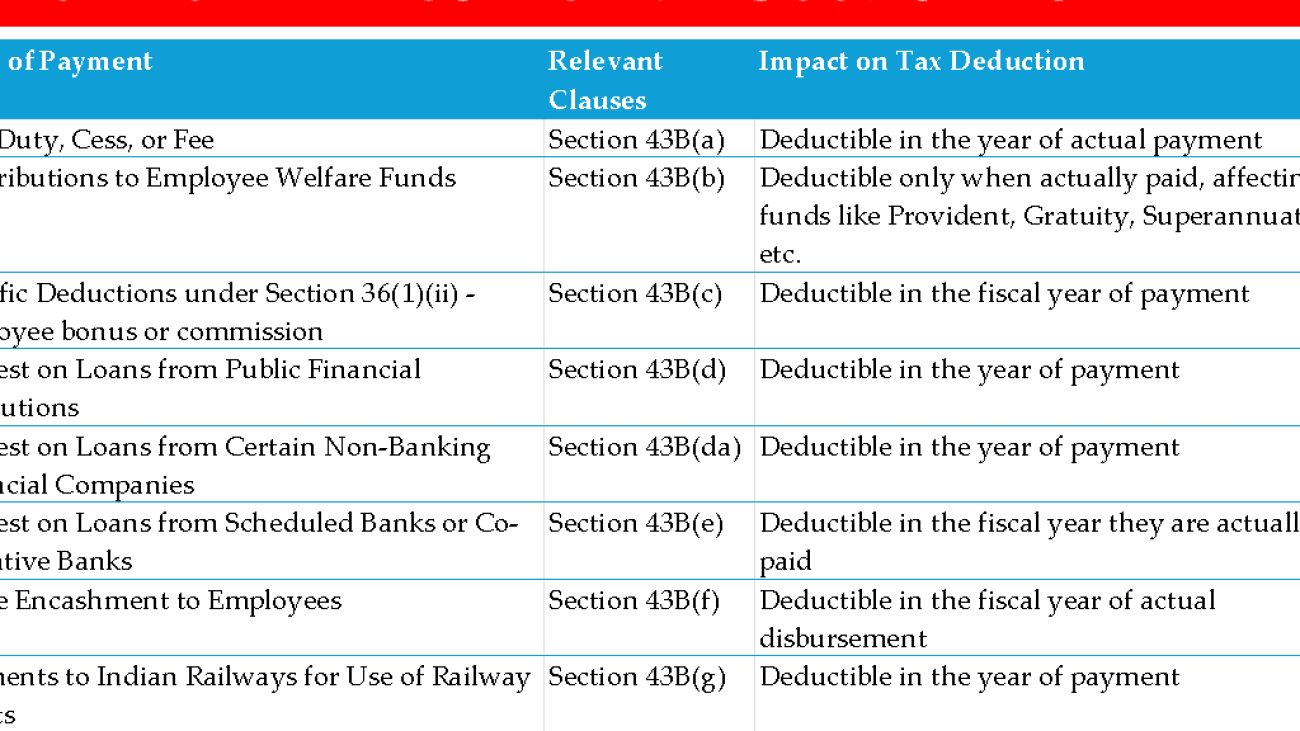
  • Tax, Duty, Cess, or Fee (Section 43B(a)): Taxes, duties, cesses, or fees become deductible only in the year they are actually paid.
  • Contributions to Employee Welfare Funds (Section 43B(b)): Payments towards funds like Provident Fund, Gratuity Fund, etc., are deductible in the year of payment.
  • Specific Deductions under Section 36(1)(ii) (Section 43B(c)): Certain specified deductions are recognized only in the year of actual payment.
  • Interest on Loans from Public Financial Institutions (Section 43B(d)): Interest on such loans is deductible in the fiscal year they are paid.
  • Interest on Loans from Certain Non-Banking Financial Companies (Section 43B(da)): Similar to public financial institutions, interest paid to certain NBFCs is deductible in the year of payment.
  • Interest on Loans from Scheduled Banks or Co-operative Banks (Section 43B(e)): This clause allows the deduction of interest on loans from these banks in the year they are paid.
  • Leave Encashment to Employees (Section 43B(f)): Deductions for leave encashment are recognized in the year they are actually disbursed.
  • Payments to Indian Railways for Use of Railway Assets (Section 43B(g)): Payments made to Indian Railways for the use of assets are deductible in the year of payment.
  • Payments to Micro or Small Enterprises Beyond Specified Time Limit (Section 43B(h)): This ensures timely payments to these enterprises, with deductions applicable in the year of payment.

Impact on Businesses:

Section 43B significantly influences business financial planning, emphasizing the importance of timely payments for tax deductions. It affects cash flow, as deductions can only be claimed when the actual payment is made, leading to higher reported profits and tax liabilities in the year expenses are incurred but not paid. This necessitates meticulous financial planning and proactive cash flow management for businesses.

The incorporation of Section 43B into the Income Tax Act has a profound impact on business taxation, primarily by altering the timing of tax deductions. This section enforces a ‘payment’ over ‘accrual’ basis, influencing the taxable income and tax liability of businesses.

Specific Scenarios Illustrating the Impact:

Broader Implications:

The broader implications of Section 43B are especially significant for businesses with substantial deferred expenses. It necessitates a proactive approach in financial management and an emphasis on timely payments. Additionally, the section underlines the importance of maintaining robust financial records and fostering prompt payment practices, particularly towards micro and small enterprises and in dealings with public financial institutions, NBFCs, scheduled banks, and co-operative banks.

Conclusion

Section 43B of the Income Tax Act stands as a significant provision impacting the financial management of businesses. It underscores the importance of the ‘payment’ basis over the ‘accrual’ method for specific expenses, influencing tax deductions and, subsequently, the taxable income. Businesses must adapt to this provision by prioritizing timely payments, particularly in areas such as employee welfare funds, interest on loans, and payments to micro and small enterprises.

This calls for enhanced financial planning and disciplined cash flow management. As businesses navigate through these taxation waters, adhering to the stipulations of Section 43B is not just about compliance but also about strategic financial planning to optimize tax liabilities. In essence, Section 43B encourages a more prudent and timely approach to financial obligations, which can ultimately lead to healthier business practices and relationships.

demo-attachment-678-IMG_9265-80146-original-protected-scaled

What to do if teammates do not appreciate you?

When, while the lovely valley teems with vapor around me, and the meridian sun strikes the upper surface of the impenetrable foliage of my trees, and but a few stray gleams steal into the inner sanctuary, I throw myself down among the tall grass by the trickling stream; and, as I lie close to the earth, a thousand unknown plants are noticed by me: when I hear the buzz of the little world among the stalks, and grow familiar with the countless indescribable forms of the insects and flies, then I feel the presence of the Almighty, who formed us in his own image, and the breath of that universal love which bears and sustains us, as it floats around us in an eternity of bliss; and then, my friend, when darkness overspreads my eyes, and heaven and earth seem to dwell in my soul and absorb its power, like the form of a beloved mistress, then I often think with longing, Oh, would I could describe these conceptions, could impress upon paper all that is living so full and warm within me, that it might be the mirror of my soul, as my soul is the mirror of the infinite God!

O my friend — but it is too much for my strength — I sink under the weight of the splendor of these visions! A wonderful serenity has taken possession of my entire soul, like these sweet mornings of spring which I enjoy with my whole heart. I am alone, and feel the charm of existence in this spot, which was created for the bliss of souls like mine.

I am so happy, my dear friend, so absorbed in the exquisite sense of mere tranquil existence, that I neglect my talents. I should be incapable of drawing a single stroke at the present moment; and yet I feel that I never was a greater artist than now.

When, while the lovely valley teems with vapor around me, and the meridian sun strikes the upper surface of the impenetrable foliage of my trees, and but a few stray gleams steal into the inner sanctuary, I throw myself down among the tall grass by the trickling stream; and, as I lie close to the earth, a thousand unknown plants are noticed by me: when I hear the buzz of the little world among the stalks, and grow familiar with the countless indescribable forms of the insects and flies, then I feel the presence of the Almighty, who formed us in his own image, and the breath of that universal love which bears and sustains us, as it floats around us in an eternity of bliss; and then, my friend, when darkness overspreads my eyes, and heaven and earth seem to dwell in my soul and absorb its power, like the form of a beloved mistress, then I often think with longing, Oh, would I could describe these conceptions, could impress upon paper all that is living so full and warm within me.

demo-attachment-675-giammarco-zeH-ljawHtg-unsplash-scaled

Why getting a consultant is the best decision

When, while the lovely valley teems with vapor around me, and the meridian sun strikes the upper surface of the impenetrable foliage of my trees, and but a few stray gleams steal into the inner sanctuary, I throw myself down among the tall grass by the trickling stream; and, as I lie close to the earth, a thousand unknown plants are noticed by me: when I hear the buzz of the little world among the stalks, and grow familiar with the countless indescribable forms of the insects and flies, then I feel the presence of the Almighty, who formed us in his own image, and the breath of that universal love which bears and sustains us, as it floats around us in an eternity of bliss; and then, my friend, when darkness overspreads my eyes, and heaven and earth seem to dwell in my soul and absorb its power, like the form of a beloved mistress, then I often think with longing, Oh, would I could describe these conceptions, could impress upon paper all that is living so full and warm within me, that it might be the mirror of my soul, as my soul is the mirror of the infinite God!

O my friend — but it is too much for my strength — I sink under the weight of the splendor of these visions! A wonderful serenity has taken possession of my entire soul, like these sweet mornings of spring which I enjoy with my whole heart. I am alone, and feel the charm of existence in this spot, which was created for the bliss of souls like mine.

I am so happy, my dear friend, so absorbed in the exquisite sense of mere tranquil existence, that I neglect my talents. I should be incapable of drawing a single stroke at the present moment; and yet I feel that I never was a greater artist than now.

When, while the lovely valley teems with vapor around me, and the meridian sun strikes the upper surface of the impenetrable foliage of my trees, and but a few stray gleams steal into the inner sanctuary, I throw myself down among the tall grass by the trickling stream; and, as I lie close to the earth, a thousand unknown plants are noticed by me: when I hear the buzz of the little world among the stalks, and grow familiar with the countless indescribable forms of the insects and flies, then I feel the presence of the Almighty, who formed us in his own image, and the breath of that universal love which bears and sustains us, as it floats around us in an eternity of bliss; and then, my friend, when darkness overspreads my eyes, and heaven and earth seem to dwell in my soul and absorb its power, like the form of a beloved mistress, then I often think with longing, Oh, would I could describe these conceptions, could impress upon paper all that is living so full and warm within me.

demo-attachment-672-patrick-fore-H5Lf0nGyetk-unsplash-scaled

Research and strategy are vital for the market

When, while the lovely valley teems with vapor around me, and the meridian sun strikes the upper surface of the impenetrable foliage of my trees, and but a few stray gleams steal into the inner sanctuary, I throw myself down among the tall grass by the trickling stream; and, as I lie close to the earth, a thousand unknown plants are noticed by me: when I hear the buzz of the little world among the stalks, and grow familiar with the countless indescribable forms of the insects and flies, then I feel the presence of the Almighty, who formed us in his own image, and the breath of that universal love which bears and sustains us, as it floats around us in an eternity of bliss; and then, my friend, when darkness overspreads my eyes, and heaven and earth seem to dwell in my soul and absorb its power, like the form of a beloved mistress, then I often think with longing, Oh, would I could describe these conceptions, could impress upon paper all that is living so full and warm within me, that it might be the mirror of my soul, as my soul is the mirror of the infinite God!

O my friend — but it is too much for my strength — I sink under the weight of the splendor of these visions! A wonderful serenity has taken possession of my entire soul, like these sweet mornings of spring which I enjoy with my whole heart. I am alone, and feel the charm of existence in this spot, which was created for the bliss of souls like mine.

I am so happy, my dear friend, so absorbed in the exquisite sense of mere tranquil existence, that I neglect my talents. I should be incapable of drawing a single stroke at the present moment; and yet I feel that I never was a greater artist than now.

When, while the lovely valley teems with vapor around me, and the meridian sun strikes the upper surface of the impenetrable foliage of my trees, and but a few stray gleams steal into the inner sanctuary, I throw myself down among the tall grass by the trickling stream; and, as I lie close to the earth, a thousand unknown plants are noticed by me: when I hear the buzz of the little world among the stalks, and grow familiar with the countless indescribable forms of the insects and flies, then I feel the presence of the Almighty, who formed us in his own image, and the breath of that universal love which bears and sustains us, as it floats around us in an eternity of bliss; and then, my friend, when darkness overspreads my eyes, and heaven and earth seem to dwell in my soul and absorb its power, like the form of a beloved mistress, then I often think with longing, Oh, would I could describe these conceptions, could impress upon paper all that is living so full and warm within me.

demo-attachment-1158-227032926-84112-original-protected-scaled

Review Of Healthy Breakfast Meals For Energy Boost

When, while the lovely valley teems with vapor around me, and the meridian sun strikes the upper surface of the impenetrable foliage of my trees, and but a few stray gleams steal into the inner sanctuary, I throw myself down among the tall grass by the trickling stream; and, as I lie close to the earth, a thousand unknown plants are noticed by me: when I hear the buzz of the little world among the stalks, and grow familiar with the countless indescribable forms of the insects and flies, then I feel the presence of the Almighty, who formed us in his own image, and the breath of that universal love which bears and sustains us, as it floats around us in an eternity of bliss; and then, my friend, when darkness overspreads my eyes, and heaven and earth seem to dwell in my soul and absorb its power, like the form of a beloved mistress, then I often think with longing, Oh, would I could describe these conceptions, could impress upon paper all that is living so full and warm within me, that it might be the mirror of my soul, as my soul is the mirror of the infinite God!

O my friend — but it is too much for my strength — I sink under the weight of the splendor of these visions! A wonderful serenity has taken possession of my entire soul, like these sweet mornings of spring which I enjoy with my whole heart. I am alone, and feel the charm of existence in this spot, which was created for the bliss of souls like mine.

I am so happy, my dear friend, so absorbed in the exquisite sense of mere tranquil existence, that I neglect my talents. I should be incapable of drawing a single stroke at the present moment; and yet I feel that I never was a greater artist than now.

When, while the lovely valley teems with vapor around me, and the meridian sun strikes the upper surface of the impenetrable foliage of my trees, and but a few stray gleams steal into the inner sanctuary, I throw myself down among the tall grass by the trickling stream; and, as I lie close to the earth, a thousand unknown plants are noticed by me: when I hear the buzz of the little world among the stalks, and grow familiar with the countless indescribable forms of the insects and flies, then I feel the presence of the Almighty, who formed us in his own image, and the breath of that universal love which bears and sustains us, as it floats around us in an eternity of bliss; and then, my friend, when darkness overspreads my eyes, and heaven and earth seem to dwell in my soul and absorb its power, like the form of a beloved mistress, then I often think with longing, Oh, would I could describe these conceptions, could impress upon paper all that is living so full and warm within me.